DoneDocket Book a walkthrough

For alterations & tailoring shops

Take the order. Print the docket.
Text them when it's ready.

DoneDocket is the counter system for alterations businesses — job dockets in seconds, receipts a tailor can work from, the week's workload in dollars, and customers texted the moment their job is ready. Built by an alterations shop owner, for alterations shop owners.

The DoneDocket day board: customers-waiting, in-store and replies strips, the day headline with jobs and dollars, and docket cards for the day's work.

22,400+ real orders and counting  ·  every screen below is the real product

The counter

Order in, docket out — under a minute.

Tap the garment, tap the alteration — it's priced from your own price list automatically. Add the measurement note, take the money, print.

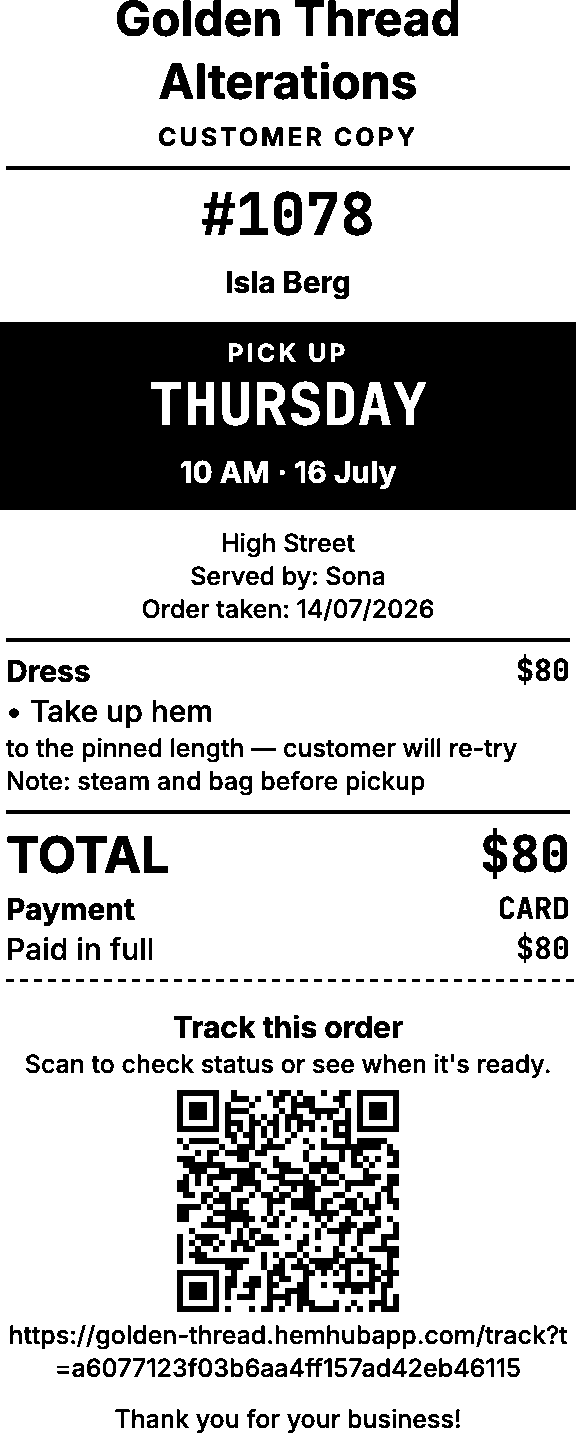
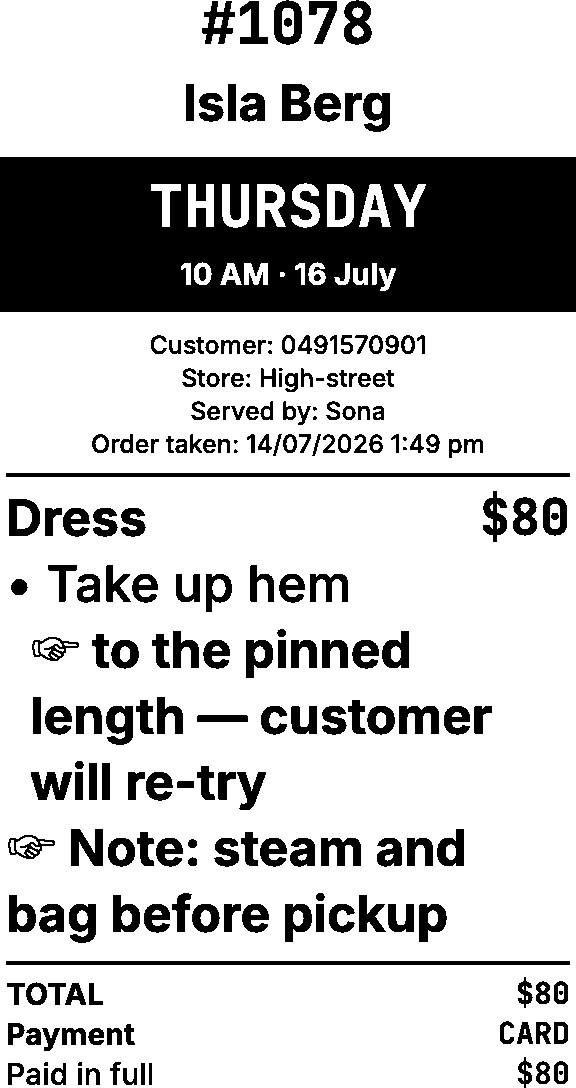
Two copies come off the receipt printer you already own. The customer's copy shows what's owing, plus a QR code they can scan to check on their order. The store copy is the work docket — the pickup day in a bold black band, the customer's name big enough to spot on the rack, the measurement note in heavy type.

The order canvas: garment tile grid on the left, the live docket on the right with two items, the customer, pickup date and total.
The printed customer receipt: pickup day in a black band, items, total, paid in full, and the tracking QR code.
Customer copy — QR and balance.
The printed store docket: the pickup day band, the work in large type, and the measurement note marked with a pointing hand.
Store copy — the rack docket.

Shown exactly as they print.

The board

Know what today's worth — and where next week has room.

Jobs land on the day they're due, each one a docket card with its garments, notes and what's owing. The headline reads the day for you: how many jobs, what they're worth, what's still to do. Tomorrow's total is one glance away, the calendar shows which days are already heavy, and the order form warns you before you promise another coat on an overloaded Thursday.

The day navigation: yesterday and tomorrow peek buttons labelled with their dollar totals either side of today's headline.
Yesterday and tomorrow, with their totals, either side of today.
A docket card: suit jacket with its alterations and notes, status stamps, paid-by-card chip, and a Mark ready button.
One job, one docket — work, notes, money, action.
The month popover with days tinted by booked workload.
The whole month, shaded by how busy each day is.

Customers

The phone stops ringing.

Mark a job ready and the customer gets a text — their name, their order, automatically, every time. The receipt's QR code opens a live order page, so “is it ready yet?” answers itself; when they're on the way, one tap tells your counter they're coming to collect. And if they text back, the reply shows up right on their order — answer it in a tap.

The customer's order page on a phone: Ready to collect, the items, and an I'm-here-to-collect button.
What your customer sees.
An order's message thread: booking confirmation, ready text, the customer's reply, and the staff answer.
The whole conversation, on the order.
The customers-waiting strip on the board: Freya here to collect 4 minutes ago, Marcus asking when ready.
“I'm here to collect” — on your board, seconds later.

Finished a job at 9 pm? The text waits until you're open.

Deposits & balances

Take a deposit — or none. The balance follows the job.

Half up front is how alterations actually works, so DoneDocket treats it properly: take a deposit at the counter, or send the job out unpaid, and what's owing stays on the job — on the docket, the board and the pickup screen — until it's collected. No notebook of who-still-owes-what: the collect button already knows the number.

Card payments work with the EFTPOS terminal you already have — and a direct connection through Linkly (certified by ANZ, CBA, NAB, Westpac and 11 more banks) is rolling out, so the total lands on the terminal without retyping.

The payment sheet with Deposit selected: $40 of an $80 total via the 50% shortcut, remaining $40 due at pickup, and a Save-unpaid option.
A deposit at the counter — the rest is due at pickup.
The collect-at-pickup panel: hand-over checklist, the balance due, and Collect cash or card buttons.
At pickup, the balance is right there to collect.

Your team

Know who did what — and pay them right.

Everyone works under their own four-digit PIN, so every order, payment and change carries a name — no shared logins, no guessing, and the full history is always there. Shifts and breaks clock in on the same screen, and payroll comes out the other end with your overtime rules already applied, ready for your bookkeeper.

The shop iPad's entry screen: the shop's name and a four-digit PIN pad.
The whole login, for staff.

Reviews

More Google reviews — without asking at the counter.

After pickup, customers get a one-minute survey by text — your questions, your wording. Scores and comments come straight back to you, and posting a Google review is one tap from the thank-you screen. Your rating grows while you sew.

The survey on a phone: quality, service and recommendation scales, 0 to 10.
Thirty seconds, three taps.
The review step: five stars, a thank-you, and a Post a Google review button.
One tap to your Google page.

Also in the box

The rest, at a glance.

Self check-in kiosk

New customers sign themselves up on a counter iPad — and appear on your board instantly.

Analytics

Takings by day, who did how much, and your busiest days at a glance.

Full history

Every order keeps its own timeline; every job ever, one searchable table.

Store credit

Give credit, spend it at pickup — refunds come back as credit automatically.

More than one store

Per-store hours, pricing, receipts and review links — same board, same system.

Silent printing

Receipts print instantly on the printer you already own — nothing to maintain.

Any device

iPads at the counter, the owner's phone at home — any browser, nothing to install.

Your data, your address

Your shop runs at its own private address — yourshop.donedocket.com — and your data stays yours.

Born behind a real counter.

DoneDocket is the system behind Alter Ego — one of Melbourne's highest-volume alterations shops. Running on it, Alter Ego grew from one store to two in under six months, and its counters have earned over 400 five-star Google reviews in two years. When DoneDocket opened up to other shops, it carried Alter Ego's 22,000 orders and 12,000 customers across without losing a single one. Every feature on this page exists because a tailor needed it on a Tuesday.

1 → 2 stores in <6 months  ·  22,400+ orders  ·  ★★★★★ 400+ Google reviews

Questions

Do I need new hardware?

No. DoneDocket prints to the standard receipt printers most alterations shops already own — one small install on the counter computer, and it looks after itself from then on.

Can you bring our history across?

Yes — migration is part of onboarding. Orders, customers, balances, the lot.

What do staff need to learn?

A four-digit PIN. The board is a diary; the order form is tap-tap-done. Shops have switched over in a morning.

How do the texts work?

Your shop gets its own text number with a monthly bundle of texts included. Customers can reply — replies land on your board.

What does it cost?

Three plans, month to month: Solo $49, Shopfront $99, Multi-store $199 — founding rates while the beta runs, no lock-in contracts. See pricing.

See DoneDocket on your own counter.

A 20-minute walkthrough with the people who built it — bring your trickiest job and we'll run it through.

Book a walkthrough